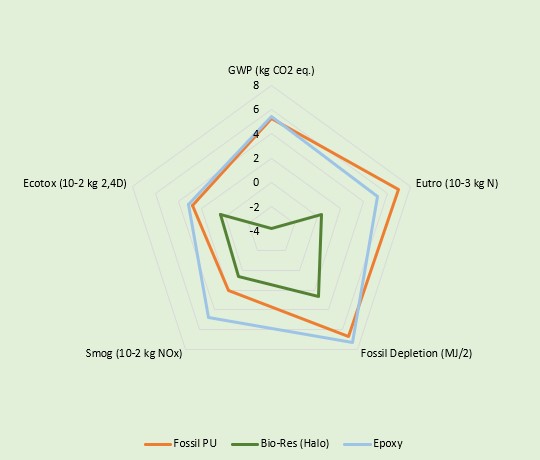
Polyurethanes, epoxies and other thermoset materials have been available since the 1930’s.
Surprisingly, many of today’s products are based on vintage chemistry from that time period. Our aim is to provide our entire product range based on 21st Century chemistry, a chemistry using waste, vegetable-based materials.

In line with the agreed objectives of Composites UK, we aim to focus on the delivery of high-performance composites based on the use of bio-carbon derivatives and recycled materials.
There is clearly a vital role for vegetable-based chemistry in today’s tooling industry, not only in tooling boards as such but also in allied products such as sealers, adhesives, fast-cast resins and RIM (Reaction Injection Moulding) materials. It is now possible to produce high-performance, vegetable-derived materials that equal, or even surpass, the properties of petrochemical-based products.
We have already introduced our Halo-S tooling board, which has met with great enthusiasm from engineers based in the composites industry. The mechanical and thermal properties of Halo-S allow it to be used in high-temperature applications, with Tg and CTE values that compare favourably with more conventional products. Again, this is an important and unrivalled polymer development.

Formulating improved, low GWP, high-performance thermoset materials is a mixture of art and science.
Following 50 years of thermoset chemistry, our Chairman, Dr. Barrie Colvin FRSC, has put together a series of compounds which can be regarded as our building blocks for future composite developments.

Traditional polyurethane based on petrochemical carbon atoms

Traditional epoxy based on petrochemical carbon atoms
Bio-carbon derived molecules are depicted with green-coloured carbon atoms, normally obtained from a renewable, vegetable-based origin:
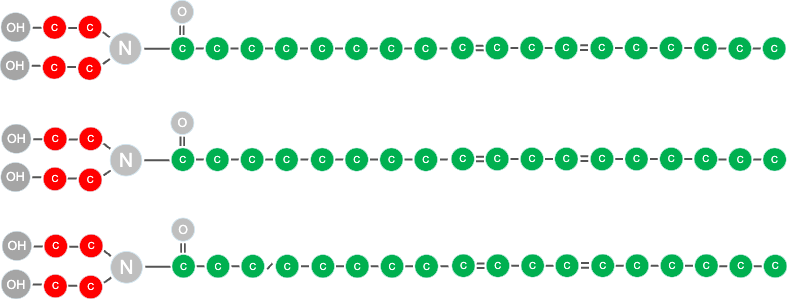
Triglyceride material containing a high level of vegetable-based carbon atoms
The examples given above represent a simplistic overview of the approach taken to demonstrate the differences between traditional materials and those currently used by Rubix Tooling Board.
In reality, a wide range of more complex, sustainable resins have been developed, as shown below.
This palette of basic chemical structures allows us to formulate any type of high-performance product with unrivalled sustainability attributes. This includes tooling boards, pastes, adhesives, RIM materials, Fast-Cast materials and other specialist resins. These compounds form part of our range of sustainable building blocks.
|
Bio-Res® Grade
|
% Bio-Carbon (ASTM D6866-22)
|
Remarks
|
|---|---|---|
|
Bio-Res® 2107 |
76 |
Optimised for tooling board |
|
Bio-Res® 2205 |
68 |
Optimised for Fast-Cast |
|
Bio-Res® 2215 |
11 |
Contains 68% recycled content |
|
Bio-Res® 2238 |
19 |
Contains 74% recycled content |
|
Bio-Res® 2288 |
77 |
Optimised for paste |
|
Bio-Res® 2300 |
65 |
Optimised for RIM (FR-Grade) |
|
Bio-Res® 2306 |
99 |
Optimised for 1200D tooling board |
|
Bio-Res® 2310 |
98 |
General purpose grade |
|
Bio-Res® 2406 |
78 |
Optimised for R-Cell® Mouldings |
Plastic pollution is the scourge of the current generation. The immense quantities of plastic waste in our oceans is outrageous. Currently, it is estimated that 10 million tonnes is added to our oceans every year, resulting in a situation whereby at these addition levels, there will be more plastic than fish in the sea by 2050.

Greenpeace Demonstration
The overriding emphasis must be to replace conventional plastics with other, non-polluting alternatives. In addition, we must all endeavour to recycle plastics whenever possible. To this end, several of our sustainable materials contain raw materials derived from waste plastic, in addition to bio-based products. More importantly, many materials currently manufactured in the composites industry could utilise products derived from waste plastic. A combination of bio-carbon chemistry and optimised processing of waste plastics could lead to a very positive contribution by the composites industry.